The iPhone Duo and the new Siri AI may look like separate hardware and software stories. Together, they show how Apple is answering a larger question: what should a phone become when AI needs to understand the screen, use applications and work with personal information?
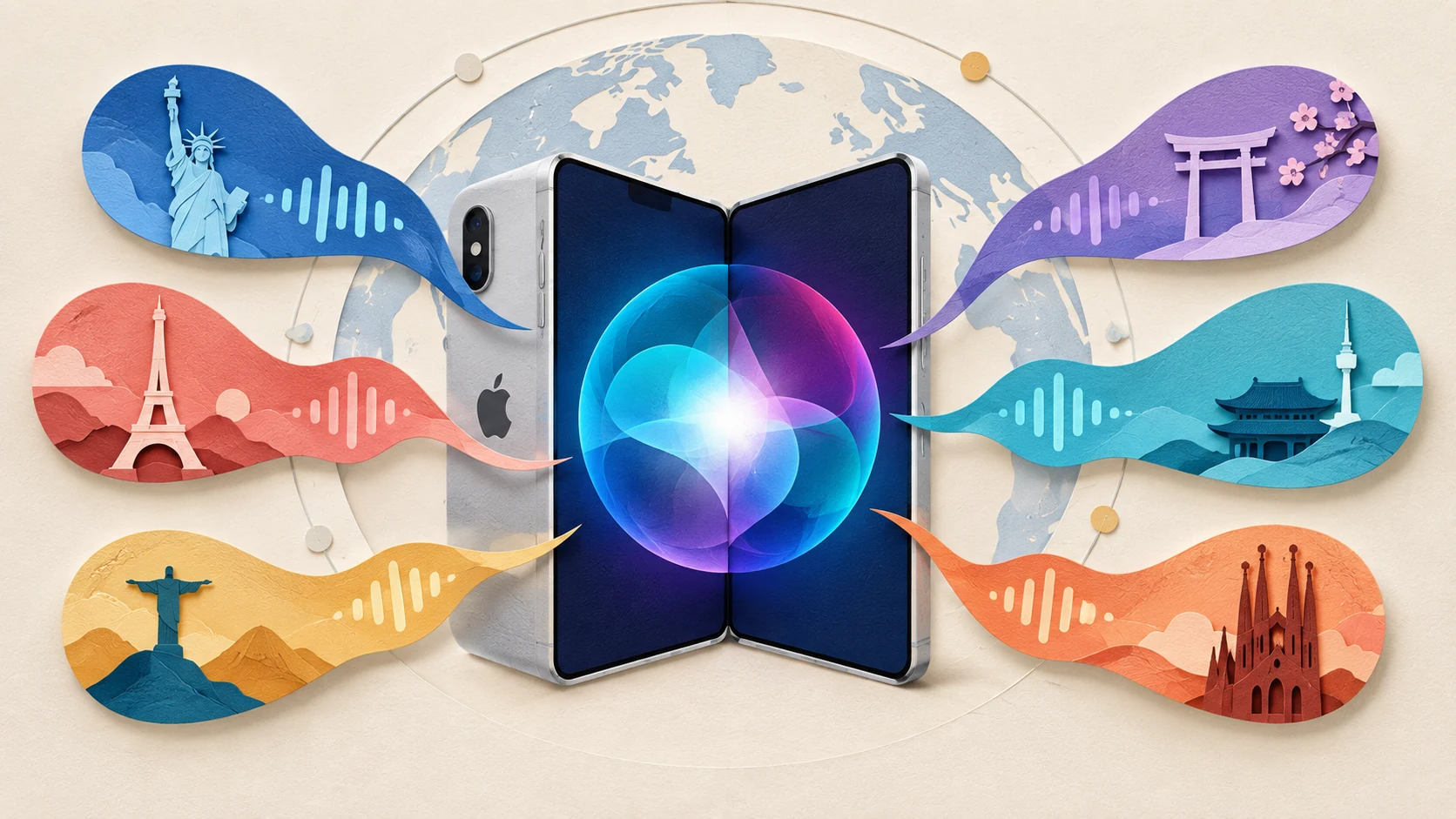
The first generation of smartphones put the internet in our pockets. The next generation is trying to put a personal AI there as well—one that can understand private context and take action through the applications people already use.
Apple’s 2026 introduction of iPhone Duo and the next generation of Siri AI initially looks like two separate announcements. One is a foldable hardware product. The other is a generative AI system.
Viewed together, however, they reveal a single strategy. Apple is redesigning the phone around an assistant that can see more, remember more and act across the operating system.
iPhone Duo is more than a foldable iPhone
iPhone Duo is Apple’s first foldable iPhone. It has a 5.4-inch outer display and opens to reveal a 7.6-inch inner display.
Treating it only as Apple’s late response to the foldable market misses its strategic significance.
A conventional phone screen is optimized for one primary task at a time. Working with AI often requires two contexts at once: the source material and the response, an email and the calendar, a meeting and the list of follow-up actions.
On iPhone Duo, a user can continue a conversation with Siri AI on one side of the screen while reading a document or using another application on the other. The larger canvas is therefore not simply more screen. It is a better surface for human-AI collaboration.
Apple has also equipped the device with A20 Pro, a dual 16-core Neural Engine and higher unified-memory bandwidth. According to Apple, the Neural Engine offers twice the compute power for on-device AI models, while a vapor chamber helps sustain demanding AI and multitasking workloads.
The foldable design provides interaction space. A20 Pro provides local computing power. Siri AI connects that hardware to applications and personal context.
Apple Intelligence and Siri AI have different language coverage
One of the most common mistakes in discussions of Apple AI is to treat Apple Intelligence language availability and the rollout of the new Siri AI as the same thing.
They are not.
Apple says Apple Intelligence is available when Siri and the device language are set to Simplified Chinese, Traditional Chinese, Danish, Dutch, English, French, German, Italian, Japanese, Korean, Norwegian, Portuguese, Spanish, Swedish, Turkish or Vietnamese. Some individual features still vary by language and region.
The new Siri AI is rolling out more gradually. It launched in beta in English. Apple says support for French, Japanese, Korean, Portuguese and Spanish is coming in October 2026.
Having an Apple Intelligence-supported device language therefore does not mean that every new Siri AI capability is available in that language.
This distinction matters because Apple’s challenge is much larger than translating menus. It must make an agent that understands personal context, screen content and cross-application instructions work reliably across different languages and cultural conventions.
Multilingual AI requires more than translation
Traditional voice assistants could map many requests to predefined intents such as setting an alarm, checking the weather or making a call.
The new Siri AI must handle open-ended instructions such as:
Compare the times my French client sent last week with my child’s school events and my Tokyo travel plans, then find a meeting time that works for everyone.
That request may include names and places written in different languages. It also requires the system to understand email, calendars, time zones and implied references.
A multilingual agent must handle several problems at once:
- Different grammar, honorifics and patterns of omission
- Code-switching between two or more languages in one request
- Multiple spellings of names, companies and places
- Local date, address and business conventions
- Region-specific applications, payment services and regulations
Japanese is a useful case because subjects are often omitted and honorific language can materially change meaning. Similar difficulties arise in Korean, Portuguese and Spanish, as well as in markets where people routinely mix languages in the same conversation.
The multilingual Siri AI rollout is not simply the addition of more voice packs. It is a test of whether Apple’s models, application orchestration and localization data can operate globally.
Siri is becoming a system-level agent
Apple’s description of Siri AI contains several important changes.
The first is personal context. Within the user’s permissions, Siri can search across messages, email, photos and applications. A person should not need to remember which email contains a flight confirmation code before asking about the trip.
The second is onscreen awareness. Siri can answer questions about what the user is viewing and take action based on that content.
The third is cross-application action. A system orchestrator can use the Spotlight index and App Toolbox to combine functions from different applications into a multi-step task.
The fourth is continuity across devices. Apple has introduced a dedicated Siri application, with conversation history syncing through iCloud across iPhone, iPad, Mac, Apple Watch and Apple Vision Pro.
Siri is no longer positioned only as the animation that appears after a user presses a side button. It is becoming a personal agent layer across Apple’s product line.
Apple’s hardware advantage also creates fragmentation
OpenAI, Meta and xAI can update cloud agents quickly. Apple must support a very large installed base of devices with different processors and memory capacities.
General Apple Intelligence support includes iPhone 15 Pro and iPhone 15 Pro Max, as well as compatible iPhone 16 and later models. Apple’s most capable on-device model and advanced voice features, however, require newer hardware with at least 12GB of unified memory. Supported devices include iPhone Duo, iPhone 18 Pro, iPhone Air and the iPhone 17 Pro line.
That creates several tiers of experience:
- Some devices can run general Apple Intelligence features
- Some can use Siri AI but depend more heavily on cloud processing
- Newer devices can run Apple’s strongest on-device model
- Some regions cannot initially access the complete feature set
Apple also says that features relying on server-side models are subject to daily usage limits. Expanded access will be offered for a fee in the future.
Apple Intelligence may therefore develop into more than a free feature bundled with the operating system. Hardware sales, iCloud subscriptions and paid AI compute could gradually form a new service package.
A multilingual rollout is not the same as a global rollout
Language support alone does not determine where Siri AI is available.
Apple says Siri AI will not initially be available in the European Union on iOS, iPadOS and watchOS while the company works on an approach that it says will preserve privacy and security. Siri AI and other new Apple Intelligence features will also remain unavailable in China while Apple addresses regulatory requirements.
The global availability map is therefore determined by four conditions: whether the model supports the language, whether the device can handle the required processing, whether Apple’s cloud architecture can operate in the region and whether local regulations allow the relevant data and application access.
Two users speaking the same language may receive very different Siri AI experiences because they live in different jurisdictions.
The phone is becoming the body of personal AI
The most important feature of iPhone Duo may not be that it folds. It may be that the product demonstrates how AI can reshape hardware.
An assistant needs cameras to interpret the physical world, microphones for conversation, local processors for private computation, a large display for showing its work and an operating system that can authorize actions across applications.
The smartphone is becoming more than an entry point to AI. It is becoming the AI’s eyes, ears, identity credential and action surface.
Apple is betting that the most important personal agent will not necessarily belong to the company with the largest model. It may belong to the platform that best understands the user’s devices, applications, location and personal context.
If multilingual Siri AI works as promised, the basis of iPhone competition will change. Customers will not only be choosing a phone with a better camera. They will be choosing a personal computing system based on whether it understands their language, their region and the way they live and work.