The center of AI competition is moving. The question is no longer only which model gives the smartest answer. It is which agent can remember a long-term goal, operate real software, keep working after the user leaves and stop before it crosses a permission boundary.
For the past few years, people have judged AI with a simple question: how good is its answer?
In 2026, that question is becoming incomplete. A new generation of AI products is no longer content to wait inside a chat box. These systems have cloud computers, browsers, persistent memory and access to applications. They can continue working while the user is offline, read email, update customer records, build websites, organize meeting notes and process invoices. Some are designed to notice work that has not yet been assigned.
Chatbots are not disappearing, but the center of the industry is shifting toward a more consequential contest: who can build the first genuinely useful cloud AI coworker?
From answering questions to completing work
The basic unit of a conventional chatbot is an answer. A user asks a question, the model generates a response and the interaction ends. Even when the model can write code or analyze a document, the user often has to move the output into the software where the real work happens.
The basic unit of an AI agent is a result.
“Review this week’s customer meetings and prepare follow-up emails” is not complete when the model produces a generic email template. An agent must find the meeting notes, identify each customer, retrieve relevant history, draft the appropriate message, ask for approval and place the result in the correct inbox.
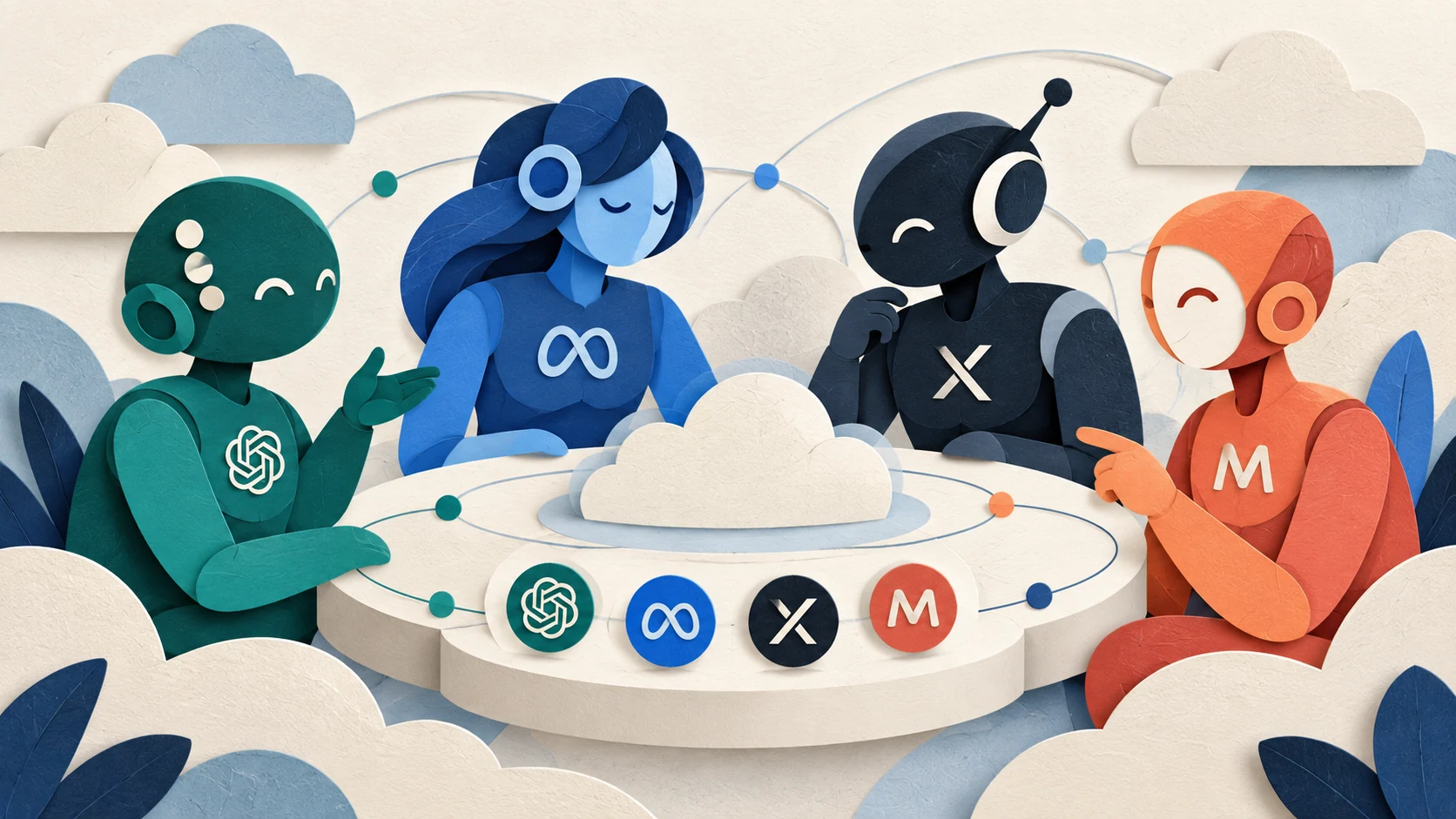
That is the common direction behind OpenAI Dots, Meta Muse, xAI Grok Bot and Manus 2.0. Each is trying to turn AI from an adviser that suggests the next step into an operator that carries it out.
Four products with different definitions of an AI coworker
| Product | Core position | Where it works | Distinctive strength | Current limitation |
|---|---|---|---|---|
| OpenAI Dots | Persistent personal and enterprise agents | Dedicated cloud computer | GPT-6 Astra, more than 4,000 app connections, proactive research and learned preferences | Gradual rollout with market and plan restrictions |
| Meta Muse | Personal and small-business agent | Muse Secure VM | Consumer planning, business connectors and a separate Sentinel safety agent | Initially concentrated in the United States |
| Grok Bot | Teams of cooperating agents | Persistent cloud computer | Multiple Bots can coordinate, use group chats and work across websites | Still in beta, with enterprise governance continuing to develop |
| Manus 2.0 | General production and creation workspace | Cloud Computer | Research, websites, slides, video, games and scheduled automation | Complex product and credit structure makes direct comparison difficult |
The vendors do not disclose all the specifications that buyers might expect. Complete model parameter counts, virtual-machine memory and storage allocations are often unavailable. Unverified claims about billions of parameters or a specific number of gigabytes should not be treated as product facts.
For an agent, those numbers may not be the most useful comparison anyway. Reliability, application access, retained context, approval behavior and recovery after failure usually matter more than raw parameter count.
OpenAI Dots are designed to find work proactively
OpenAI describes Dots as always-on agents. Each Dot has its own cloud computer and browser, runs on GPT-6 Astra and can connect to more than 4,000 applications through OpenAI’s plugin ecosystem.
The main difference from an ordinary ChatGPT conversation is continuity. A Dot can keep working in the background, advance several projects and communicate through ChatGPT, Slack, Microsoft Teams or a voice call.
OpenAI gives the example of an early tester whose Dot noticed that he had forgotten to invoice a publication. The Dot prepared the invoice and sent it only after receiving approval.
It is a small example, but it signals a major change. The AI is not simply following a direct command. It is identifying work the user intended to do but had not explicitly assigned.
OpenAI has also placed limits around that autonomy. Proactive background research uses read-only tools by default. It cannot send messages, alter application content or control a computer without the appropriate permission. Account changes and information-sharing actions are checked against built-in rules, custom rules and approval requirements.
The real Dots product is therefore not only a model. It is the combination of a model, cloud computer, connectors, memory, monitoring and an approval system.
Meta Muse connects agents to personal life and small business
Muse’s advantage does not come entirely from model performance. It also comes from Meta’s existing social and commercial networks.
Muse can assist with shopping, travel, schedules and longer-term goals. Users can reach it through dedicated experiences and services such as WhatsApp. Muse for Small Business can connect to Shopify, Stripe, QuickBooks, Notion, Slack, Zoom, Canva, Instagram and Facebook business accounts.
For a small shop, that could mean one agent reading sales data, organizing customer feedback, preparing social media content and planning a marketing campaign without a separate automation product for every step.
Meta runs Muse in a dedicated Secure VM. A separate Sentinel agent operates alongside it but is isolated at the system level. Sentinel reviews what Muse attempts to send to the internet and asks the user for permission when required. Meta also says the small-business product will not publish, send or spend without approval.
That architecture points toward a broader trend. Future agents may not have one undivided “brain.” A task agent may work alongside separate agents responsible for security, identity and budget controls.
Grok Bot turns one assistant into a team
Grok Bot emphasizes the idea of an AI teammate.
It works on a persistent cloud computer and can sign in to applications, websites and older systems that lack a clean API. Users can create multiple Bots for sales, finance, recruiting, operations or engineering.
Those Bots can message one another, share project context and divide work in a group conversation. A chief-of-staff Bot might break down a goal, route customer information to a sales Bot, send invoices to an operations Bot and hand a software defect to an engineering Bot.
This is not merely single-agent automation. It is a lightweight AI organizational structure.
The design also creates new management problems. Do all Bots share the same permissions? Can one Bot see another Bot’s sensitive information? Can an error propagate as the Bots hand work to one another? At what point does the cost of supervising an AI team offset the labor it saves?
Manus 2.0 is becoming a production workspace
Manus was one of the earlier general-purpose agents to turn autonomous execution into a complete product experience.
Manus 2.0 combines a Cloud Computer, automations, creation tools and a new agent harness in a single workspace. It can perform research, build websites, create presentations, edit video, develop games, operate databases and run scheduled tasks.
Compared with Dots and Muse, Manus is more strongly oriented toward the production chain from an idea to a finished deliverable. Its focus is not only a persistent character that knows the user. It is the ability to complete many types of project inside one environment.
That explains the steady addition of video, slides, hosting and development tools. Manus increasingly resembles a small AI-powered production studio rather than a conversational assistant.
The rest of the industry is building similar systems
The market extends well beyond these four products.
Google’s Gemini Enterprise Agent Platform offers long-running agents, persistent memory, agent identities, a registry and a central permission gateway. Microsoft has introduced Copilot Autopilot as a persistent agent that keeps working in the background. Salesforce explicitly describes Agentforce as a digital labor platform.
Anthropic, Amazon, Adobe, ServiceNow, Oracle and SAP are approaching the same opportunity from their strongest positions. Some are competing for software development, some for cloud infrastructure, some for enterprise workflows and others for design or content production.
The agent market is therefore unlikely to be won by a single universal product. It may separate into three layers: long-term personal agents, general cloud coworkers for teams and specialized agents embedded in finance, sales, engineering, legal and other business systems.
The real contest is not intelligence alone
The large-model era focused on parameter counts, context windows and benchmark scores.
The agent era will require different measures: how long a task can run, how often a person must intervene, how frequently an agent makes consequential mistakes, how many real tools it can use and whether its actions can be audited after something goes wrong.
A chatbot hallucination may produce a disappointing answer. An agent hallucination with access to email, payments or a database can produce a real loss.
The competition to build cloud AI coworkers is therefore not about giving a chatbot a friendly name and an avatar. It is about building a complete digital labor system with identity, permissions, memory, tools, supervision, audit trails and accountability.
The chatbot is not gone. It is becoming the communication window through which people manage an AI coworker.