AI in Insurance: what works, what doesn't, and what it costs (October 2026)
Insurers already use AI widely, mostly behind the scenes. In a regulator survey, 84% of health insurers reported using AI or machine learning, and auto insurers used claims models mainly as an information resource for adjusters, not to approve or deny. Lemonade reports that its bot takes 96% of first notices of loss and fully automates about 55% of claims, though that is company data. Courts and states are now pushing back on algorithmic denials. Start with adjuster assistance and document extraction, keep a person on every denial and pricing decision, and test for bias.
State of AI in Insurance · October 2026
As of October 2026, AI is ready to assist claims adjusters, still early for fully automated claims, health-plan models and underwriting support, and not ready to deny coverage, analyze biometrics or set prices without human review, consent and bias testing.
- Assisting claims adjusters
- Reviewing photos of losses
Backed by trials or large deployments
- First notice of loss by bot
- Health-plan utilization and fraud models
- Life underwriting support
- Algorithm-assisted Medicare Advantage decisions
Promising, limited outcome data
- Algorithm-only claim denials
- Claim video without biometric consent
- Pricing on untested external data
Evidence says avoid or add safeguards
What AI can reliably do in Insurance today
- 1
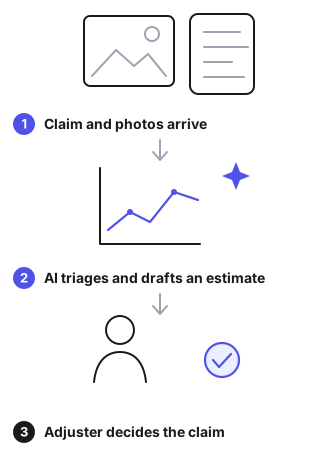
Proven Support claims adjusters with models for triage, assignment, settlement estimates and review of loss photos.
Evidence
NAIC private-passenger-auto survey of 193 insurers (collected 2021, reported Dec 2022): 135 used AI/ML in claims, 96 mostly as an information resource for adjusters, 9 for approvals, none for denials; 55 used image evaluation of losses. Source ↗
- 2
Early Take first notice of loss and process simple claims from start to finish without a person.
Evidence
Lemonade annual filing for 2024: its bot AI Jim takes first notice of loss without human intervention 96% of the time, and roughly 55% of claims were automated. Company-reported, not independently audited. Source ↗
- 3
Early Run models for utilization management, prior authorization and fraud detection in health plans, under governance programs.
Evidence
NAIC health survey, reported May 2025: 84% of 93 insurers in 16 states (survey Nov 2024 to Jan 2025) use AI/ML; about 92% report governance frameworks. Adoption data, with no outcome data on accuracy or denials. Source ↗
- 4
Early Support life-insurance underwriting and pricing with models that mostly augment rather than replace underwriters.
Evidence
NAIC life survey, fall 2023, 161 insurers: 58% use, plan or explore AI/ML; of pricing and underwriting models, 38% automate decisions and 52% augment human decisions; 54% were built by third parties. Source ↗
- 5
Early Use algorithms to assist Medicare Advantage coverage decisions, if each decision rests on the individual's circumstances.
Evidence
CMS FAQ, Feb 6, 2024 (as summarized by Reed Smith; CMS original not retrieved): plans may use AI and algorithms in coverage determinations if they follow applicable law and consider the specific individual's circumstances. Source ↗
What it can't do, or where the risk is
- 1
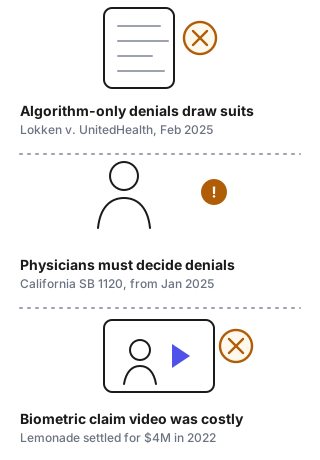
Can't Deny or cut off care with an algorithm without a clinician reviewing the individual case.
Evidence
Estate of Lokken v. UnitedHealth, D. Minn., Feb 13, 2025 (Judge Tunheim): breach-of-contract and good-faith claims proceed over alleged use of the nH Predict algorithm; five other claims were dismissed. Plaintiffs allege over 90% of denials were reversed on appeal. These are allegations, not findings. Source ↗
- 2
Can't Let an algorithm make the final medical-necessity denial in a California health plan.
Evidence
California SB 1120 (Physicians Make Decisions Act), effective Jan 1, 2025: a licensed physician or competent health professional, not an AI algorithm, must make final decisions to deny, delay or modify care on medical-necessity grounds. Source ↗
- 3
Can't Analyze biometric data from claim videos without consent in Illinois.
Evidence
Clarke v. Lemonade, DuPage County, Ill. (No. 2022LA000308): $4 million settlement over biometric data from video claims made June 25, 2019 to May 27, 2021, with deletion of collected data. Lemonade denied the allegations. Source ↗
- 4
Can't Use external consumer data and algorithms without testing for unfair discrimination (Colorado).
Evidence
Colorado Division of Insurance, SB21-169: insurers using external data, algorithms or predictive models must test for unfair discrimination and take corrective action. Amended Regulation 10-1-1 took effect Oct 15, 2025 for life and private-passenger-auto underwriting and for all health practices. Source ↗
- 5
Can't Count batch sign-offs on denials, at seconds per case, as individual medical review.
Evidence
Kisting-Leung v. Cigna, E.D. Cal., Mar 30, 2025 (Judge Drozd): ERISA wrongful-denial claim survives dismissal. The complaint alleges over 300,000 denials in two months of 2022, with physicians spending an average of 1.2 seconds per request. Allegations, not findings. Source ↗
Where to start
Small agency or broker
Use AI to draft client emails and summarize policy documents, and check every coverage statement against the policy wording before you send it.
Carrier or claims team
Use models to help adjusters triage and review, keep a licensed person on every denial, and log model versions, data sources and bias-test results for state AI rules.
Policyholder
If coverage is denied or cut off, ask in writing who reviewed it and whether an algorithm was used, and use the appeal process. Do not rely on a chatbot's answer about what is covered.
Regulation & risk
Laws, rules and official guidance that commonly apply when AI is used in Insurance.
| Name | Applies to | Official source | When it applies |
|---|---|---|---|
| NAIC Model Bulletin on the use of AI by insurers (2023) | US (adopted state by state) | content.naic.org | AI in underwriting, claims, pricing and fraud detection; insurers need a written AI program and governance |
| Colorado SB 21-169 and Regulation 10-1-1 | US-CO | doi.colorado.gov | External consumer data, algorithms and predictive models in life, auto and health insurance |
| California SB 1120 (Physicians Make Decisions Act) | US-CA | leginfo.legislature.ca.gov | AI or algorithms used in health-plan utilization review and medical-necessity denials |
| 42 CFR 422.101 (Medicare Advantage coverage criteria) | US | ecfr.gov | Medicare Advantage plans using algorithms in coverage decisions; individual circumstances must be considered |
| EU AI Act, Annex III point 5 (life and health insurance risk assessment and pricing) | EU | artificialintelligenceact.eu | Risk assessment and pricing of natural persons for life and health insurance are high-risk |
| Illinois Biometric Information Privacy Act (BIPA) | US-IL | ilga.gov | Face or voice analysis of claim videos or calls |
| HIPAA and GDPR Art. 9 | US / EU | hhs.gov | Health data used in underwriting, claims or utilization review |
| FCRA | US | ftc.gov | Consumer reports and scores used in underwriting |
This list is a starting point for your own compliance review, not legal advice. Last reviewed 2026-10-03.
Cost & deployment reality
Verified starting prices for 3 of the tools below: $49 to $120 per month (median $95).
Carrier-grade claims and underwriting AI is sold by quote, and this review found no public price lists. Many insurers buy rather than build: in the NAIC life survey, 54% of pricing and underwriting models were developed by third parties. For an agency or broker, the practical entry cost is a general assistant such as Microsoft 365 Copilot Business at $18 per user per month on an annual term (promotional price to Dec 31, 2026; $21 list).
Compliance is a recurring cost. Colorado requires insurers using external data to test for unfair discrimination, and insurers without such systems must file an annual attestation by December 1. Litigation is the other cost: Lemonade paid $4 million to settle a biometric-privacy class action over claim videos, without admitting liability.
Regulators expect governance, not just models. In the NAIC health survey, about 92% of insurers reported AI governance frameworks, and state rules now reach specific uses: California requires a physician to make final medical-necessity denials, and Colorado's Regulation 10-1-1 covers life, private-passenger-auto and health insurance. Keep a model inventory, record data sources and model versions, and keep a licensed person on every denial.
A typical failure pattern is automation without individual review. UnitedHealth faces a class action over alleged algorithm-driven denials, and the court let contract claims proceed in February 2025, and a court let claims against Cigna proceed over an alleged 1.2 seconds of physician review per request. Both are allegations, but they show where litigation risk sits.
Scenarios and tools for Insurance
Claims & policy document extraction
| Tool | Pricing model | Free tier | Starting price | Compliance claims | Official site | Last verified |
|---|---|---|---|---|---|---|
 Extracta.ai - Data Extraction from Documents Extracta.ai - Data Extraction from Documents | Not verified | Yes: Free Trial includes 50 pages | Not verified | Not verified | Online (redirects) (2026-09-27) | 2026-10-01 |
 DOConvert - automatically extract data from document with AI DOConvert - automatically extract data from document with AI | Not verified | Not verified | Not verified | Not verified | Online (2026-09-26) | 2026-10-01 |
Fraud & abuse signals
| Tool | Pricing model | Free tier | Starting price | Compliance claims | Official site | Last verified |
|---|---|---|---|---|---|---|
 ShieldLabs ShieldLabs | Freemium | Yes: 5,000 identifications, one-time | $95 / month | Not verified | Online (2026-10-05) | 2026-10-01 |
Customer FAQ chatbot (needs human handoff)
| Tool | Pricing model | Free tier | Starting price | Compliance claims | Official site | Last verified |
|---|---|---|---|---|---|---|
 KorticalChat - custom ChatGPT chatbot with document and FAQ automation KorticalChat - custom ChatGPT chatbot with document and FAQ automation | Paid | Yes: Free trial: 300 message credits, 1 bot identity, 500 website links | Not verified | Not verified | Online (redirects) (2026-09-27) | 2026-10-01 |
Policy-document support bot (needs human handoff)
| Tool | Pricing model | Free tier | Starting price | Compliance claims | Official site | Last verified |
|---|---|---|---|---|---|---|
 DocsBot DocsBot | Freemium | Yes: Free for personal use: 1 DocsBot, 50 source pages, 100 monthly AI credits, 1 user.… | $49 / month | 2 : SOC 2, GDPR | Online (2026-10-02) | 2026-09-26 |
Customer feedback analysis
| Tool | Pricing model | Free tier | Starting price | Compliance claims | Official site | Last verified |
|---|---|---|---|---|---|---|
 Syncly - Surface real customer pains with AI feedback analysis Syncly - Surface real customer pains with AI feedback analysis | Freemium | Yes: Trial plan $0/month: unlimited search, 100 creators per search, 1 shortlist; no cr… | $120 / month | Not verified | Online (2026-09-28) | 2026-10-01 |
Vendors & implementers
No vendors listed yet.
Four ways to get this done
Editorial picks are ranked by verified facts. Sponsored slots are labeled and never affect the ranking. How to choose →
Use a tool yourself
Compare the tools listed on this page. See the tool list ↓
Hire an AI-native service
- Editorial listing · Not paidVisit patracorp.com ↗
AI-powered managed back-office services for insurance agencies and carriers, with licensed teams and expert validation.
- Editorial listing · Not paidVisit adjusto.ai ↗
AI-assisted personal property claims, from valuation software to a managed remote TPA with desk and field adjusters.
- Editorial listing · Not paidVisit covu.com ↗
Insurance agency servicing handled as tasks by AI and US-licensed COVU agents, running on top of your agency management system.
- Editorial listing · Not paidVisit elysian.is ↗
Third-party claims administrator and AI claims software for complex commercial insurance claims.
- Editorial listing · Not paidVisit harperinsure.com ↗
AI-native commercial insurance brokerage: one call and a licensed specialist handles the rest.
Recent changes: Insurance tools
Last verified: 2026-10-03 · auto-checked 2026-10-05 · Reviewed by Toolsfine editorial
- Syncly - Surface real customer pains with AI feedback analysis · pricing page URL · — → https://syncly.app/pricing ·
- Syncly - Surface real customer pains with AI feedback analysis · starting price · — → 120 ·
- Syncly - Surface real customer pains with AI feedback analysis · free tier · — → {"exists":true,"limits":"Trial plan $… ·
- Syncly - Surface real customer pains with AI feedback analysis · pricing model · — → Freemium ·
- Extracta.ai - Data Extraction from Documents · pricing page URL · — → https://www.extracta.ai/pricing ·
- Extracta.ai - Data Extraction from Documents · free tier · — → {"exists":true,"limits":"Free Trial i… ·
- Extracta.ai - Data Extraction from Documents · pricing model · — → unknown ·
- KorticalChat - custom ChatGPT chatbot with document and FAQ automation · pricing page URL · — → https://kortical.com/products/ai-agen… ·