Create social media posts with AI in 2026: how far it works, which tools, what it costs
AI drafts social posts, captions and replies in seconds, and early studies suggest well-prompted AI text can match or beat staff-written posts on engagement. The limits are about trust, not speed. Platforms require labels on realistic AI media, regulators ban fake testimonials, and models still invent facts and quotes. Use AI for drafts and repurposing, and keep a person in charge of what is published.
Where AI stands: Create social media posts with AI · October 2026
As of October 2026, AI is ready to draft and repurpose social posts, still early for matching human engagement and auto-replies, and not ready to publish unlabeled realistic media, write testimonials or vouch for facts.
- Drafting posts and captions
Backed by trials or large deployments
- Posts that match human engagement
- Auto-drafted replies and comments
- Scheduler built-in AI assistants
Promising, limited outcome data
- Realistic AI media without labels
- Fake reviews and testimonials
- Guaranteed accurate facts and quotes
Evidence says avoid or add safeguards
What works today
- 1
Proven Cut the time to draft short professional writing by about 40%.
Evidence
Noy and Zhang, Science (2023): 453 professionals wrote press releases, short reports and emails. Average time fell from 27 to 17 minutes and quality was rated about 18% higher. Social posts were not tested separately. Source ↗
- 2
Early Write posts that earn engagement comparable to or above staff-written ones.
Evidence
Public Relations Review (December 2025): GPT-4 messages outperformed human-written ones on engagement in studies using Fortune 500 Twitter posts, and trained PR professionals could not match the AI. Only the abstract was checked; effect sizes not confirmed. Source ↗
- 3
Early Draft replies and comments that get other people to respond.
Evidence
Information Systems Research study of Weibo (data from January 2024): posts that received comments from the AI bot CommentRobot got 23% more comments and 11% more likes, but posters did not become more active overall. One platform and one bot. Source ↗
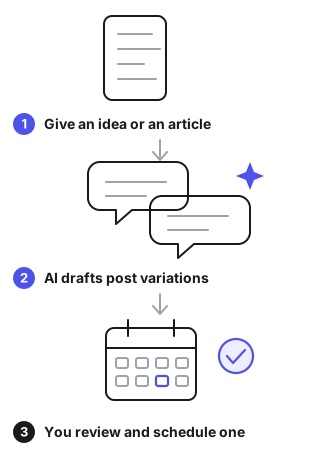
What doesn't work yet
- 1
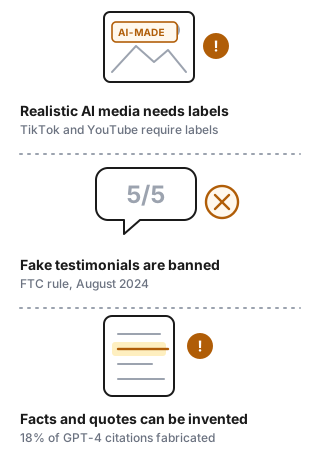
Can't Post realistic AI images, audio or video without the platform's AI label.
Evidence
TikTok support (checked October 2026) requires labels on realistic content that is completely generated or significantly edited by AI. YouTube asks creators to disclose realistic altered or synthetic content and can remove videos or suspend repeat offenders from its Partner Program. Source ↗
- 2
Can't Write fake reviews or testimonials as if from real customers.
Evidence
FTC final rule (announced 14 August 2024): bans fake reviews and testimonials, including AI-generated ones that misrepresent they are by someone who does not exist. The FTC can seek civil penalties against knowing violators. Source ↗
- 3
Can't Guarantee that the facts, quotes or links in a post are real.
Evidence
Walters and Wilder, Scientific Reports (2023): of 636 citations generated in April 2023, 55% from GPT-3.5 and 18% from GPT-4 were fabricated. A test of citations, used here as a proxy for invented facts; newer models were not tested. Source ↗
Where to start
Small business owner
Draft a week of posts from your own notes, then edit each one. Check every fact, price and quote before scheduling.
Social media manager
Use AI for variations and repurposing, and keep a person approving replies. Do not run unattended comment bots.
Creator using AI images or video
Switch on the platform's AI label for anything realistic. Never generate a real person's likeness without permission.
Tools for this task, by pricing model
Freemium
| Tool | Pricing model | Free tier | Starting price | Compliance claims | Official site | Last verified |
|---|---|---|---|---|---|---|
 Robopost AI Robopost AI | Freemium | Not verified | Not verified | Not verified | Online (2026-10-01) | Not yet |
 TwitterCopilot TwitterCopilot | Freemium | Not verified | Not verified | Not verified | Online (2026-10-03) | Not yet |
 Stella - AI Marketing Assistant Stella - AI Marketing Assistant | Freemium | Not verified | Not verified | Not verified | Online (2026-10-01) | Not yet |
Pricing not verified yet
| Tool | Pricing model | Free tier | Starting price | Compliance claims | Official site | Last verified |
|---|---|---|---|---|---|---|
 Unifire - Super AI Content Generator for Blog, Podcast, LinkedIn, Youtube, Twitter Unifire - Super AI Content Generator for Blog, Podcast, LinkedIn, Youtube, Twitter | Not verified | Not verified | Not verified | Not verified | Online (2026-09-28) | 2026-10-01 |
Typical cost
Buffer is free for up to 3 channels, Essentials costs $5 per channel a month, and Team costs $10 per channel a month; the AI Assistant is on all three. Hootsuite Standard costs $99 per user a month on annual billing, with a 14-day free trial. ChatGPT Plus costs $20 a month.
Prices were checked in October 2026. Budget time to review each post before it goes out.
Data & compliance requirements
Laws, rules and official guidance that commonly apply when AI is used in Create social media posts with AI.
| Name | Applies to | Official source | When it applies |
|---|---|---|---|
| FTC — Endorsement Guides & fake reviews rule (2024) | US | ftc.gov | AI-generated reviews, AI influencers and undisclosed promotion |
| CAN-SPAM | US | ftc.gov | AI-generated marketing email |
| TCPA | US | fcc.gov | AI voice calls and text messages |
| GDPR / ePrivacy | EU | commission.europa.eu | Consent for email and tracking |
| EU DSA (Digital Services Act) — ad transparency | EU | digital-strategy.ec.europa.eu | Platform advertising and recommender systems |
| EU AI Act Art. 50 (deepfake labeling) | EU | digital-strategy.ec.europa.eu | Synthetic people or voices in ad creative |
This list is a starting point for your own compliance review, not legal advice. Last reviewed 2026-09-24.
Failure modes
- Realistic AI media removed or penalized for missing labelsTikTok requires labels on realistic AI content, and YouTube can remove videos or suspend repeat offenders from its Partner Program. Use each platform's AI disclosure setting for realistic AI images, audio and video.Source
- Fake testimonials and AI-made reviewsThe FTC rule bans fake reviews and testimonials, including AI-generated ones. Quote only real customers, with permission. Label sponsored posts as ads.Source
- Invented facts, quotes and statisticsIn one 2023 test, 18% of GPT-4 citations and 55% of GPT-3.5 citations were fabricated. Check every number, quote and link against its source before scheduling the post.Source
- Auto-replies that read as irrelevantIn the Weibo study, bot comments drew replies when they used relevant social cues, and the bot did not raise posters' overall activity. Review each reply before posting. Do not run unattended comment bots.Source
- Likeness of real people without permissionTikTok bans AI content that shows private adults without permission, shows under-18s, or falsely shows public figures endorsing something. Do not generate real people's likeness. Use your own photos or clearly fictional characters.Source
Recent changes: tools for this task
Last verified: 2026-10-03 · auto-checked 2026-10-06 · Reviewed by Toolsfine editorial
- ViralClip · site status · Online → Unreachable ·
- AI Girlfriend - Myher · site status · Online → Unreachable ·
- CommentGuard · pricing page URL · — → https://commentguard.io/pricing ·
- CommentGuard · starting price · — → 29 ·
- CommentGuard · free tier · — → {"exists":true,"limits":"7-day free t… ·
- CommentGuard · pricing model · — → Paid ·
- Unifire - Super AI Content Generator for Blog, Podcast, LinkedIn, Youtube, Twitter · pricing page URL · — → https://www.unifire.ai/pricing/ ·
- Unifire - Super AI Content Generator for Blog, Podcast, LinkedIn, Youtube, Twitter · pricing model · — → unknown ·