AI in Ecommerce: what works, what doesn't, and what it costs (October 2026)
AI pays off in ecommerce where it removes friction. Field experiments on a large cross-border platform found sales gains of up to 16.3% from generative AI features, and machine-learning demand forecasts beat statistical baselines on Walmart data. Customer-facing automation is riskier: a chatbot's wrong answer can make the seller liable, telling shoppers they are talking to a bot cut purchases in one field experiment, and personalized pricing now carries disclosure rules.
State of AI in Ecommerce · October 2026
As of October 2026, AI in ecommerce is ready for demand forecasting and some conversion features, still early for support chat, ad images and sales bots, and not ready to replace human support, answer policy questions unchecked, or set personal prices unnoticed.
- Item-level demand forecasting
- Conversion features on large platforms
Backed by trials or large deployments
- Routine support chat
- AI-made ad images
- Voice sales bots
Promising, limited outcome data
- Chatbot policy answers unchecked
- Support with no human option
- Publishing AI-generated product reviews
- Personalized prices without disclosure
Evidence says avoid or add safeguards
What AI can reliably do in Ecommerce today
- 1
Proven Lift conversion with generative AI in product matching, customer service and advertising.
Evidence
Field experiments on a leading cross-border retail platform, 2023-2024, seven generative-AI workflows: sales gains from none detectable to 16.3%, through higher conversion; return rates and ratings did not worsen; about $5 per consumer per year across four positive applications. Source ↗
- 2
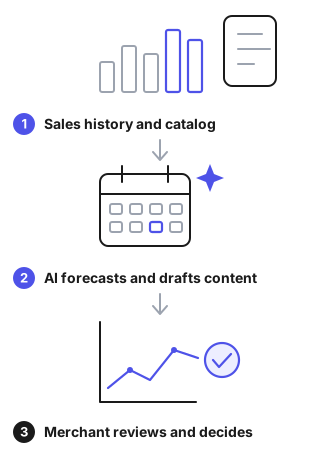
Proven Forecast item-level demand more accurately than statistical baselines.
Evidence
M5 accuracy competition (International Journal of Forecasting, 2022): 5,507 teams forecast 42,840 Walmart sales series; the winner beat the best statistical benchmark by 22.4%, but 92.5% of teams failed to beat an exponential-smoothing baseline. Source ↗
- 3
Early Handle a large share of routine support chats.
Evidence
Klarna press release, 27 Feb 2024 (company-reported): 2.3 million chats in the first month, two-thirds of its support chats; resolution time fell from 11 minutes to under 2 and repeat inquiries fell 25%. Klarna later resumed hiring human agents (see Can't). Source ↗
- 4
Early Create ad images that click as well as human-made ones.
Evidence
SSRN working paper, "AI in Disguise": 4,633 pairs of AI-generated and human-made ads from the same advertisers on Taboola, 369 million impressions; no detectable average click-through disadvantage, but images that looked AI-made did worse. Source ↗
- 5
Early Sell by voice bot about as well as experienced sales reps, when customers do not know it is a bot.
Evidence
Luo et al., Marketing Science 2019: field experiment of outbound sales calls to more than 6,200 customers; an undisclosed chatbot performed comparably to experienced workers and four times better than inexperienced ones. Single firm and 2019-era technology; disclosure changed the result (see Can't). Source ↗
What it can't do, or where the risk is
- 1
Can't Be treated as a separate party when it gives customers wrong policy information.
Evidence
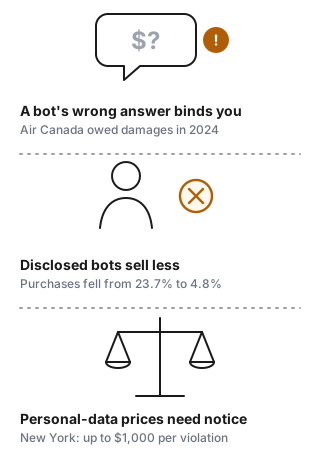
Moffatt v. Air Canada (BC Civil Resolution Tribunal, 14 Feb 2024): the airline's chatbot misstated its bereavement-fare policy; the tribunal held Air Canada responsible for all information on its website, "whether it came from a static page or a chatbot", and awarded about CA$650 plus interest and fees. Source ↗
- 2
Can't Keep conversion unchanged when customers are told up front they are talking to a bot.
Evidence
Luo et al., Marketing Science 2019 (6,200+ customers): purchase rates fell from 23.7% to 4.8%, a drop of more than 79.7%, when the bot was disclosed before the conversation; disclosing after the conversation reduced the effect. Disclosure can be legally required. Source ↗
- 3
Can't Fill product pages with AI-generated reviews and ratings.
Evidence
FTC final rule (Aug 2024) bans fake reviews, including AI-generated reviews by people who do not exist, bought reviews, undisclosed insider reviews and review suppression. Source ↗
- 4
Can't Set individual prices from personal data without regulatory exposure.
Evidence
FTC staff findings (17 Jan 2025): six intermediaries, including Mastercard, Accenture and McKinsey, serving at least 250 client businesses, used location, browsing history, mouse movements and abandoned carts for targeted pricing. New York requires the notice "THIS PRICE WAS SET BY AN ALGORITHM USING YOUR PERSONAL DATA" (GBL 349-a, up to $1,000 per violation). Source ↗
- 5
Can't Replace human support entirely without hurting service quality.
Evidence
Customer Experience Dive, 9 May 2025: Klarna resumed hiring human customer-service agents after its AI-first push; its CEO said it is "critical that you are clear to your customer that there will be always a human if you want." Trade-press report of company statements. Source ↗
Where to start
Small online store owner
Use AI for product copy and demand estimates, and fact-check every description. Never publish AI-written reviews, and check your platform's own AI tools before buying more.
Support team lead
Let a bot take routine questions from approved policy text, log every answer, and keep a clear route to a human, since the seller is responsible for what the bot says.
Pricing or merchandising lead
Test AI forecasting against your current baseline. Before using personal data in prices, ask counsel about FTC scrutiny and the New York and EU disclosure rules.
Regulation & risk
Laws, rules and official guidance that commonly apply when AI is used in Ecommerce.
| Name | Applies to | Official source | When it applies |
|---|---|---|---|
| FTC rule on fake reviews and testimonials (2024) | US | ftc.gov | AI-generated reviews and ratings on product pages |
| PCI DSS v4.0.1 | Industry standard | pcisecuritystandards.org | Any store or processor that stores, processes or transmits payment-card data |
| EU Consumer Rights Directive (Directive 2019/2161) | EU | commission.europa.eu | Shoppers must be told when a price is personalized on the basis of automated decision-making |
| New York Algorithmic Pricing Disclosure Act (GBL 349-a) | US-NY | nysenate.gov | Prices set by an algorithm using personal data need the required notice; up to $1,000 per violation |
| California BOT Act (B&P Code 17940-17943) | US-CA | leginfo.legislature.ca.gov | Bots used to incentivize a sale must not hide their artificial identity from California consumers |
| EU Digital Services Act | EU | digital-strategy.ec.europa.eu | Online marketplaces and platforms: recommender-system transparency, ad labeling and trader traceability |
| GDPR / CCPA and CPPA automated decision-making rules | EU / US-CA | cppa.ca.gov | Profiling shoppers; California finalized ADMT, risk-assessment and cybersecurity-audit regulations in September 2025 |
| EU AI Act (transparency obligations, Art. 50) | EU | digital-strategy.ec.europa.eu | Shopping chatbots and AI-generated content shown to shoppers; most obligations applicable since 2 August 2026 |
This list is a starting point for your own compliance review, not legal advice. Last reviewed 2026-10-03.
Cost & deployment reality
Verified starting prices for 2 of the tools below: $39 to $149 per month (median $94).
AI features are increasingly bundled. Shopify lists Basic at $29 a month billed yearly ($39 monthly), Grow at $79, Advanced at $299 and Plus from $2,300, with its Sidekick assistant on every plan; online card rates start at 2.9% + 30 cents on Basic and fall to 2.25% + 30 cents on Plus. Gorgias says its AI Agent is on every plan and billed only when it resolves a conversation, with helpdesk tiers from 50 to 5,000 tickets a month; check its plan page for current rates.
Returns per shopper are modest. The cross-border platform study estimated about $5 per consumer per year in incremental value across four positive applications. Klarna estimated a $40 million profit improvement for 2024 from its assistant (company-reported), then resumed hiring human agents in 2025.
Treat chatbot answers as statements by the company. In Moffatt v. Air Canada the tribunal held the airline responsible for what its chatbot said. Ground policy answers in approved text, log conversations and offer a human. Disclosure matters: purchase rates fell from 23.7% to 4.8% when customers were told up front it was a bot, yet California and EU rules can require disclosure, so test wording rather than hide it.
Pricing and content carry their own rules. The FTC found intermediaries serving at least 250 businesses used personal data for individualized prices, and New York requires a notice when prices are set by an algorithm using personal data, with civil penalties up to $1,000 per violation. For product feeds, Google says AI-generated images must carry IPTC DigitalSourceType metadata, and AI-written product copy still needs a human fact-check.
Scenarios and tools for Ecommerce
Product copy
| Tool | Pricing model | Free tier | Starting price | Compliance claims | Official site | Last verified |
|---|---|---|---|---|---|---|
 WriteText.ai for WooCommerce WriteText.ai for WooCommerce | Paid | Yes: Free trial with full access to all Pro features | $149 / month | Not verified | Online (2026-09-27) | 2026-10-01 |
 WriteText.ai for Magento WriteText.ai for Magento | Freemium | Not verified | Not verified | Not verified | Online (2026-10-01) | Not yet |
Marketplace listing SEO
| Tool | Pricing model | Free tier | Starting price | Compliance claims | Official site | Last verified |
|---|---|---|---|---|---|---|
 Amazon SEO Ranking Amazon SEO Ranking | Freemium | Not verified | Not verified | Not verified | Online (2026-10-05) | Not yet |
Virtual try-on
| Tool | Pricing model | Free tier | Starting price | Compliance claims | Official site | Last verified |
|---|---|---|---|---|---|---|
 Vmodel - AI Virtual Try-On Vmodel - AI Virtual Try-On | Not verified | Not verified | Not verified | Not verified | Online (2026-09-29) | 2026-10-01 |
 Kolors Virtual Try On Kolors Virtual Try On | Freemium | Not verified | Not verified | Not verified | Unreachable (2026-10-04) | Not yet |
Product video ads
| Tool | Pricing model | Free tier | Starting price | Compliance claims | Official site | Last verified |
|---|---|---|---|---|---|---|
 Creatify - AI Short Video Ads Generator Creatify - AI Short Video Ads Generator | Freemium | Yes: 10 monthly credits; up to 2 video ads or 20 image ads; watermarked exports | $39 / month | Not verified | Online (2026-09-29) | 2026-10-01 |
Vendors & implementers
No vendors listed yet.
Four ways to get this done
Editorial picks are ranked by verified facts. Sponsored slots are labeled and never affect the ranking. How to choose →
Use a tool yourself
Compare the tools listed on this page. See the tool list ↓
Hire an AI-native service
- Editorial listing · Not paidVisit marqvision.com ↗
AI brand protection and anti-piracy platform with managed enforcement and takedowns, plus litigation through partner law firms.
Recent changes: Ecommerce tools
Last verified: 2026-10-03 · auto-checked 2026-10-05 · Reviewed by Toolsfine editorial
- Kolors Virtual Try On · site status · Online → Unreachable ·
- Vmodel - AI Virtual Try-On · pricing model · — → unknown ·
- Creatify - AI Short Video Ads Generator · pricing page URL · — → https://creatify.ai/pricing ·
- Creatify - AI Short Video Ads Generator · starting price · — → 39 ·
- Creatify - AI Short Video Ads Generator · free tier · — → {"exists":true,"limits":"10 monthly c… ·
- Creatify - AI Short Video Ads Generator · pricing model · — → Freemium ·
- WriteText.ai for WooCommerce · pricing page URL · — → https://writetext.ai/pricing ·
- WriteText.ai for WooCommerce · starting price · — → 149 ·